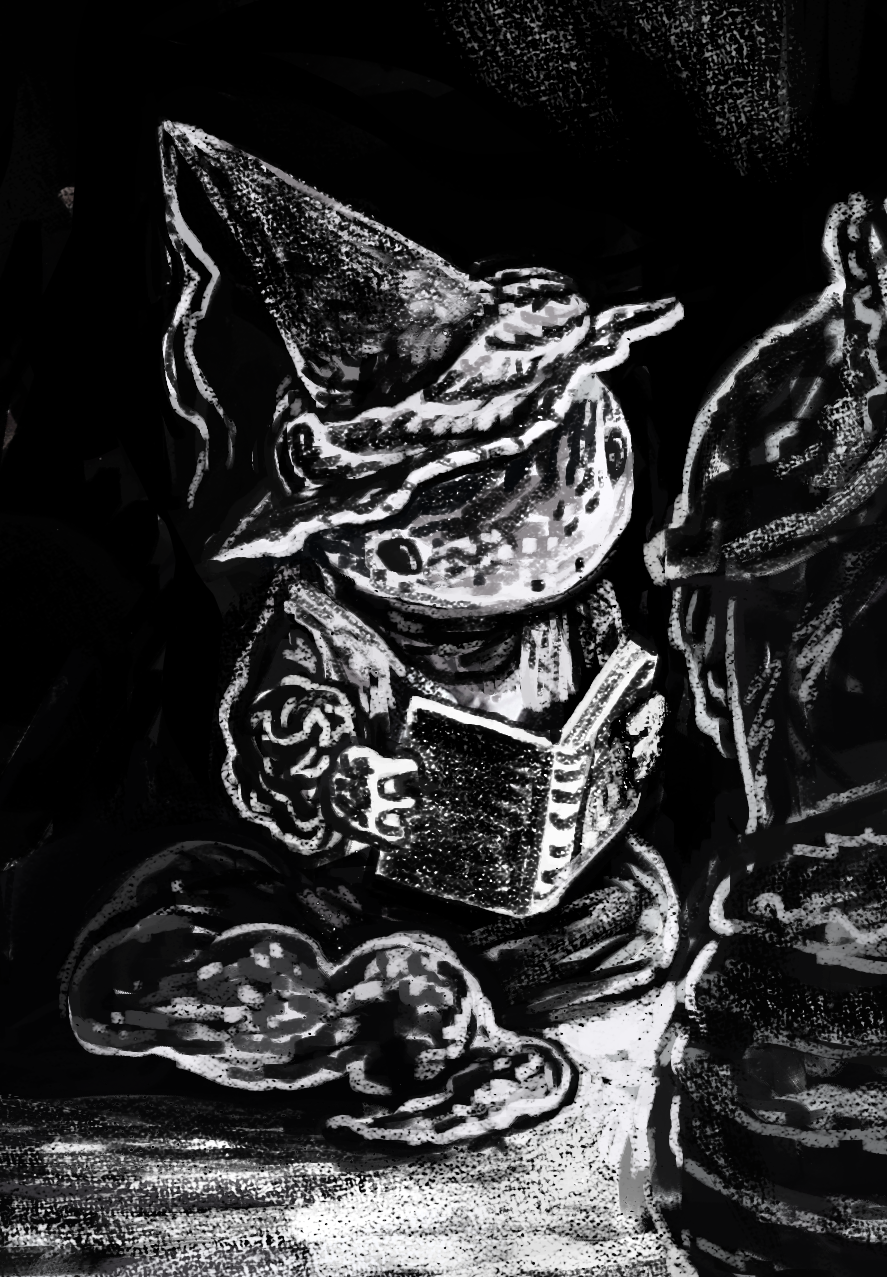

Spoilers for Dune through God-Emperor of Dune ahead:
With the recent release of Dune Part 2 in theaters (and after finally watching Part 1), I decided to revisit the titular novel Dune and three of its sequels: Dune: Messiah, Children of Dune, and God-Emperor of Dune. I had read Dune years and years ago when I was a teenager, thinking something along the lines of “This is pretty good!”, and nothing beyond that. Considering its publication date of 1965 (eleven years later than Lord of the Rings) and influence on science fiction and culture today (an effect that apparently extends to [spoilers]: Chapter 1110 of One Piece??), I thought that revisiting Dune would be enriching.
The first book Dune is a tight, well-paced science fiction novel that shows the reader a universe remarkably both alien and familiar to the reader. Starting the reader off on the lush home world of the Atreides family, Caladan, Frank Herbert introduces more and more alien concepts, such as the human super computers known as Mentats, or the intelligent and seemingly all-knowing sisterhood of the Bene Gesserit. The Atreides family, along with their heir Paul Atreides, are ordered by the Emperor to take control of the “spice” producing world of Arrakis (Dune) from their age old rivals the Harkonnens. Spice is a mind-altering drug that allows for space travel, future oracl-like powers, and life lengthening effects. It is the most precious and expensive commodity in the galaxy – leading to much of the conflict in the first and subsequent novels.
The Emperor and his family, House Corrino, use this rivalry and the Harkonnens to obliterate the Atreides family, crushing their house soon after their arrival on Arrakis. Paul, now the Duke of the Atreides, finds himself stranded on Arrakis with his mother, the Lady Jessica. Encountering the Fremen people, the native population of Arrakis, Paul takes on the role of Lisan-Al-Gaib and “Muad’Dib,” proving himself the heir to a prophecy put into Fremen by the Bene Gesserit generations and generations ago. Paul’s lineage also leads him to fulfill the role (unwanted by the Bene Gesserit and himself, ironically) of Kwisatz Haderach – a person capable of accessing both their male and female ancestral memories, hereto thought of impossible. Using his newfound powers and the religious fervor of the Fremen, Paul takes back Arrakis from the Harkonnens, disposes the Emperor, and takes his seat on the Golden Lion Throne of the Known Universe.
Dune ends thusly and allows the reader to imagine what an empire under Paul would look like. How would a prescient (this being the term Herbert uses) being, one who can see many futures, govern? How would his status as a messiah affect his empire and his life? Does Paul or others who can see their memories and future paths even have agency? If you are going to only read one book, I would stop here and allow yourself to use the subtle clues Herbert implanted in the first book to guide your thinking as to what happens after the last page. Dune: Messiah through God Emperor of Dune, however, provides satisfying enough ideas to elongate those ideas and others.
In a very short summary, Dune: Messiah explores Paul’s own governance of his empire, his feelings and thoughts as he grapples with his 61 billion death genocide by his fanatical Fremen, religious government, and his own humanity and agency. Ultimately, after surviving a coup attempt by several conspirators, Paul, at this point blinded by an atomic weapon, walks off into the desert to ostensibly die. His sister Alia takes the throne as regent, while his children Leto and Ghanima come of age. Note: Alia, Leto, and Ghanima are all “pre-born,” meaning they had access to ancestral memories as soon as they were born, leaving them in some respects less than human.
Children of Dune shows Alia well into her regency with Leto and Ghanima still as young children. Alia is going slowly insane and has her mind being taken over by the memory of Baron Vladmir Harkonnen (the antagonist of the first Dune and her grandfather). A Preacher that looks strangely like Paul starts speaking against the Fremen religion and Alia’s rule, and others, including the Lady Jessica, the Bene Gesserit, and the disposed House Corrino, plot around the throne. Leto and Ghanima, although children, have many lives of experience and plot themselves. Leto, after gaining power equal if not greater to what Paul had, decides to follow the Golden Path and lead humanity to salvation. He absorbs Sandtrouts into his body, becoming the process of becoming a Sand Worm, a spice-producing monstrosity that infest the sands of Arrakis. Leto meets the Preacher in the desert who turns out to be Paul (totally a big surprise!), and they argue about whether the path Leto is taking – the Golden Path – is the correct path. Eventually conceding, Paul supports his son, before dying at the hands of his own priesthood at the end of the book. Leto using his newfound oracular and physical prowess, usurps the throne from his aunt Alia, who in a final moment of sanity takes her own life. Leto then ushers in a new era that he tells his audience will be much, much worse than Muad’Dib’s own crusade and genocide.
God-Emperor of Dune fast forwards 3500 years to Leto mostly transformed into a Sand Worm, with only vestigial limbs and a human face remaining on a grotesque worm body. The book is largely centered around a few characters who contend with Leto’s seeming omniscience and omnipotence. Leto has been leading humanity down the Golden Path, forcing humanity to stagnate, so that once he is gone, they break out of their chains and evolve beyond what prescience can see. Through eugenics and a breeding program, Leto has managed to produce someone who cannot be seen through prescience, and a technologically advanced people known as the Ixians have developed rooms where prescience cannot see. These Ixians even gift Leto a new ambassador, Hwi Noree, a kind, empathetic woman who appeals to the humanity in Leto – showcasing a different side to the inwardly and outwardly monster. Seeming to accomplish his goals, Leto dies from an assassination attempt at the end of the novel. Will Leto’s plan work? Will 3500 years of stagnation, ruin, and tyrannical abhorrent rule (worse than Paul’s own genocide) lead humanity to a future in which they survive? It begs a central question of “do the ends justify the means?”
That is really one of the threads that really tugged at me while I read through Dune: Messiah, Children of Dune, and God-Emperor of Dune. Paul forsook the Golden Path because he did not have what it took to endure thousands of years (and potentially forever if Leto’s statements are accurate) of torture. Paul was too human for his own good. It took Paul’s own child, one who is seemingly not human to put humanity on the path towards survival. The other options that both Paul and Leto saw were far, far worse – extinction and the like. There is an element of unreliable narrator and the intentionally ambigious explanation fo how prescience works that leads to questions over the validity of Paul and Leto’s choices in the first place. Regardless, I feel that even if 3500 if not more years of oppression and degradation were necessary for the survival of the human race, does the human race deserve to survive after that. Would not 500 years of a good existence be preferable to 3500 years of oppression and the potential for the same? Paul was human, and even in the face of his prescience he made human decisions. Leto was only partly human and made far more callous decisions than Paul. Should someone like that truly be in charge of humanity’s course, regardless of the outcome?
There are of course many other themes and threads in the Dune novels outside human decision making, notwithstanding those from the two I have not read —Heretics of Dune and Chapterhouse: Dune. Threads of governance, religion, economics, technology, colonialism, and gender, to name a few. My goal in this post was to draw attention to a central theme of the first four books – that of the means vs the ends, that of decision makers and costs to their own humanity. And if nothing else, who wouldn’t get a kick out of too many mentions and thoughts of “Does Leto II the sand worm have a penis?”
P.S. Yes, Duncan Idaho exists, less as a character and more of a plot device in my opinion. I don’t know if that’s controversial or not!
 The Studious Salamander
Leave a comment